
XAI, from its first steps to frontier crossing
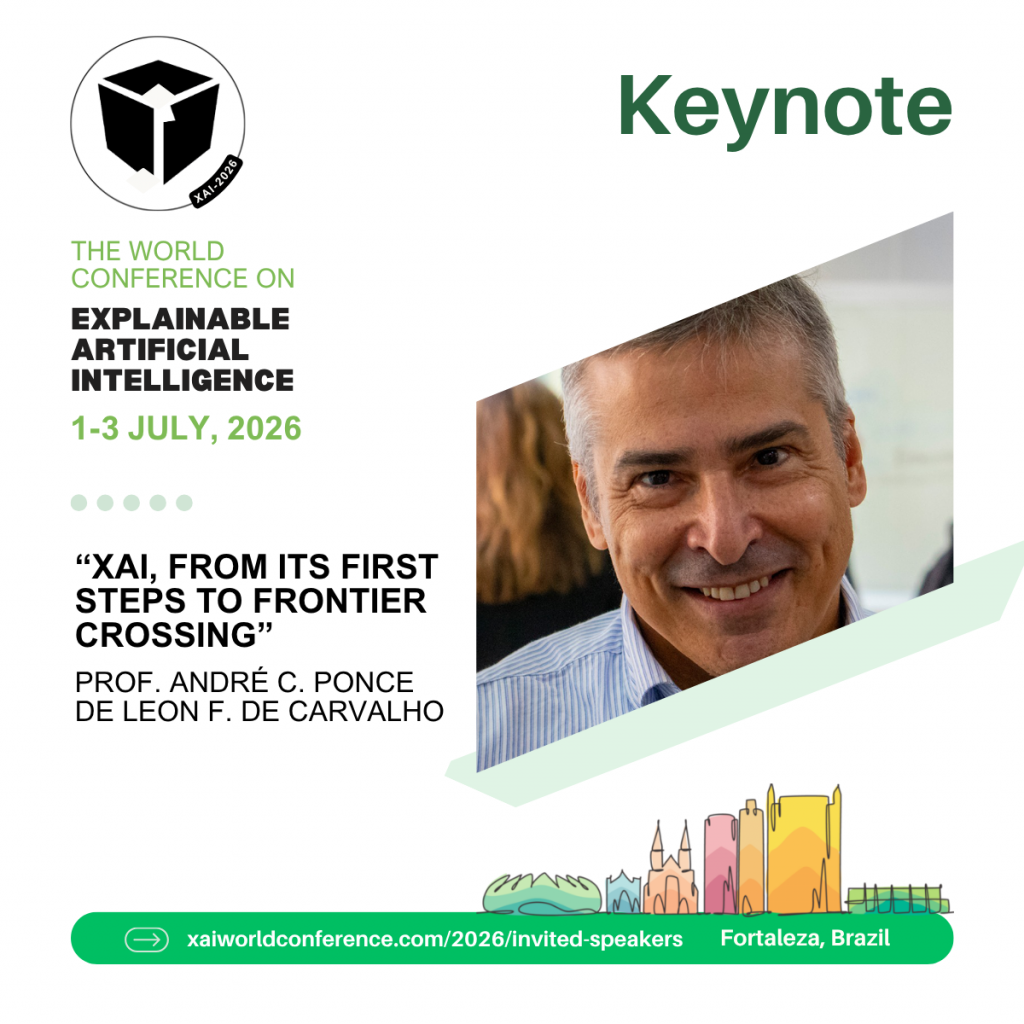
Abstract – Since the renewed interest in artificial neural networks during the 1980s, there has been an increasing push to understand and explain how these systems make decisions. This opacity often fueled intense debates between proponents of connectionist approaches—centered on neural networks—and advocates of symbolic methods based on logical rules, dividing the AI community into distinct camps.
In this talk, we will revisit the early efforts within the neural network community to move toward more explainable, connectionist AI, illustrating through selected examples how these developments proved valuable across different domains of knowledge.
Biography
André Carlos Ponce de Leon Ferreira de Carvalho has a PhD in Electronic Engineering from the University of Kent, UK, in Artificial Intelligence. He is a Full Professor and the current Dean of the Institute of Mathematics and Computer Science, University of São Paulo (ICMC-USP), Brazil. He is also Director of the Brazilian Applied AI Research Centre IARA (Research Centre for Smart Environments), Coordinator of the Embrapii Unit in Data Science at ICMC-USP. He is a member of the Computer Science Advisory Committee of the Brazilian National Councilfor Scientific and Technological Development (CNPq), from 2024 to 2027, of the Steering Committee of the International Network for Government Science Advice (INGSA) Latin American and Caribbean Chapter, of the Partnerships Board at the UKRI Centre for Doctoral Training in Accountable, Responsible and Transparent AI (ART-AI), University of Bath, UK of the UK Expert Advisory Panel of State of Science Report for the risks associated with frontier AI and of the International Federation for Information Processing (IFIP) Technical Committee on Artificial Intelligence (AI), where he is the Chair of the Working Group Machine Learning and Data Mining. He is an assessor ad hoc for several national and international funding Agencies. He was an Associate Professor at the University of Guelph, Canada and a visiting researcher at the University of Porto, Portugal and at the Alan Turing Institute, UK, and a visiting professor at the University of Kent, UK. He was Vice President of the Brazilian Computer Society (SBC) for two terms, 2019-2021 and 2021-2023.
