
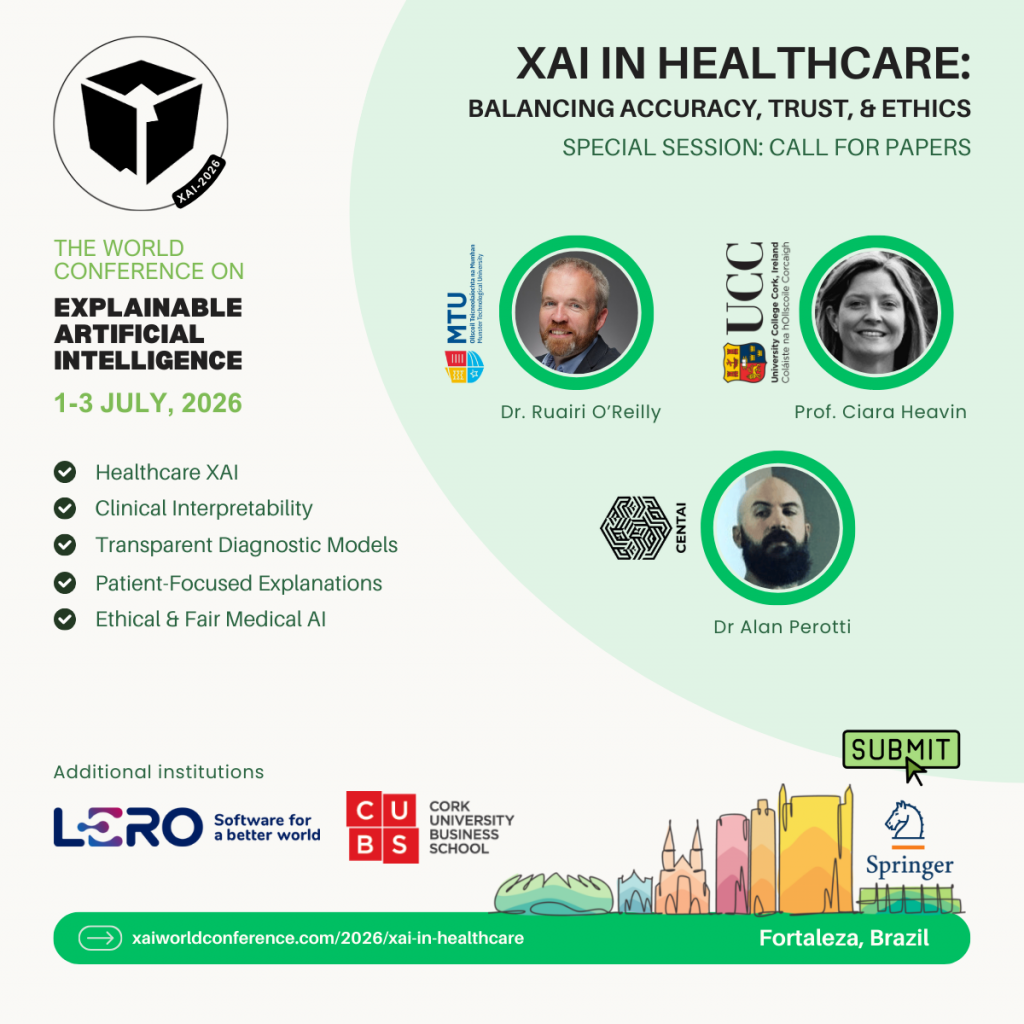
Explainability is a key consideration in healthcare, as AI systems are increasingly adopted—from aiding medical diagnoses to optimising treatment planning and predicting patient outcomes. Explainable Artificial Intelligence (xAI) methods enable practitioners and patients to understand and trust AI-driven insights, promoting more ethical, transparent, and effective healthcare.
The integration of xAI in healthcare represents a critical frontier in modern medical informatics. As AI models become increasingly complex and opaque, clinicians, regulators, and patients require clarity regarding how AI-driven recommendations are generated, particularly in high-stakes domains such as diagnostics, treatment planning, and disease prediction.
However, deploying xAI in healthcare presents significant challenges:
- Balancing Accuracy and Interpretability: Striking a trade-off between highly accurate yet complex models and interpretable, user-friendly ones.
- Integration with Clinical Workflows: Ensuring usability by practitioners while complementing existing processes.
- Data and Domain Complexity: Addressing diverse data types and pipelines such as three-dimensional medical imaging, time series from continuous monitoring, ICD-10 ontologies, federated models, and anonymised patient records.
- Ethical Concerns: Ensuring fairness, protecting privacy, maintaining informed consent, and safeguarding patient autonomy.
- Regulatory Hurdles: Navigating strict compliance frameworks that increase development and deployment complexity.
Balancing Value and Values is central to these challenges – xAI in healthcare is not only about delivering accurate predictions but also about ensuring that clinicians and patients can understand and trust the underlying decision processes. Transparency strengthens confidence, while ethical safeguards help prevent bias and inequity. Ultimately, the goal is to harmonise measurable benefits—such as improved outcomes and efficiency—with human values including dignity, empathy, and fairness.
This special session aims to explore cutting-edge xAI methods, evaluation techniques, interactive tools, and ethical considerations in clinical contexts. Areas of interest include, but are not limited to:
- Methods and Techniques for Explainability: LIME, SHAP, Integrated Gradients, Partial Dependence Plots, Counterfactual Explanations, and Attention Maps.
- Evaluation Frameworks: Expert evaluations, user feedback, cognitive load assessments, quantitative quality metrics, and ethical reviews.
- Human-Centric Design: Interactive interfaces, visualisation tools, natural language explanations, and personalised explanations for patients vs. clinicians.
- Ethical and Regulatory Challenges: Fairness, transparency, bias identification and mitigation, privacy, accessibility, and ongoing monitoring.
This session will serve as a platform for researchers, practitioners, and ethicists to collaborate, share insights, and shape the future of transparent and trustworthy AI in healthcare. By fostering dialogue across disciplines, it seeks to redefine the role of AI in advancing both the efficacy and ethics of modern healthcare.
Keywords: Healthcare XAI, Clinical Interpretability, Transparent Diagnostic Models, Patient-Focused Explanations, Ethical & Fair Medical AI, Bias & Privacy Safeguards, Workflow-Aligned XAI Tools, Trustworthy Clinical AI
Topics
- Advanced xAI methods for medical imaging interpretation
- Time-series analysis explainability for patient monitoring
- Personalisation of xAI for healthcare professionals and patients
- Counterfactual explanations in treatment recommendation systems
- Ethical considerations in healthcare xAI deployment
- Privacy-preserving explainable AI methods
- Trust evaluation metrics in xAI-driven healthcare applications
- Explainability for federated learning in clinical settings
- Cognitive load assessments in xAI tools
- Explainable AI for multi-modal healthcare data fusion
- Human-centric design in medical AI systems
- Regulatory frameworks and compliance for xAI in healthcare
- SHAP and LIME applications in clinical decision support
- Visual explanation techniques for diagnostic AI systems
- Fairness and bias mitigation in healthcare AI models
- Integration of xAI in electronic health record systems
- Explainability for predictive models in disease progression
- Usability studies of xAI in telemedicine applications
- Interactive tools for real-time AI explanation in emergency care