
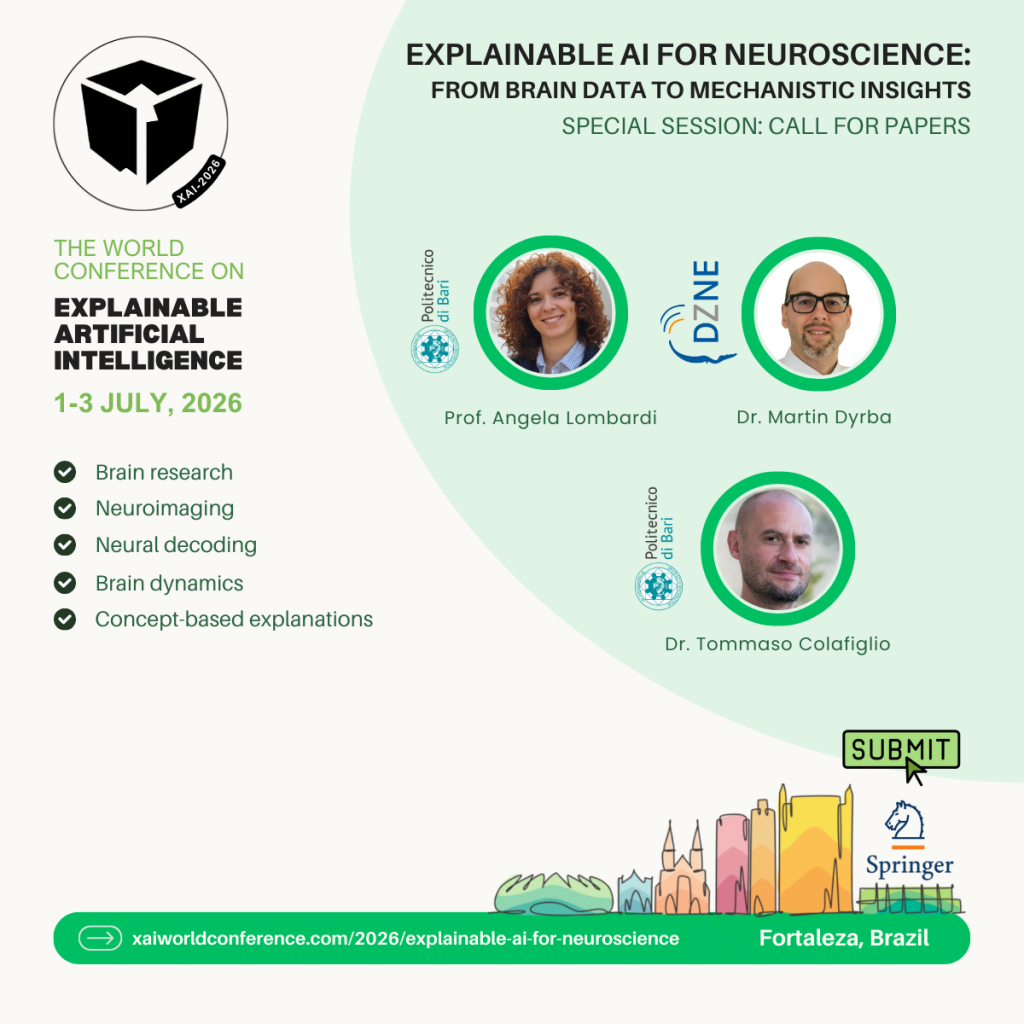
Neuroscience is undergoing a profound transformation driven by the availability of large-scale, multimodal data (e.g., fMRI, EEG/MEG, calcium imaging, intracranial recordings, behavioural and digital phenotyping data). Machine learning and deep learning models are increasingly used to decode neural signals, predict clinical outcomes, and generate hypotheses about brain function. However, the lack of transparency in many state-of-the-art models has become a critical bottleneck for scientific understanding, clinical trust, and the ethical deployment of these models. Explainable AI (xAI) provides a principled toolkit to address this challenge; however, its methods are rarely tailored to the specific questions, constraints, and evaluation standards of neuroscience.
This special session aims to bring together researchers in xAI, computational neuroscience, neuroimaging, neurology, and psychiatry to foster a dialogue on how to design, evaluate, and deploy explainable models for brain research and brain-related clinical applications. The session will highlight both (i) methodological advances in xAI that are relevant for neural data and (ii) domain-driven case studies where explainability leads to new mechanistic insights or more trustworthy clinical tools.
We explicitly focus on explanations that are meaningful for neuroscientists and clinicians, going beyond generic feature attributions. Topics include interpretable representations of neural dynamics, concept-based explanations aligned with cognitive constructs, causal and counterfactual explanations grounded in experimental manipulations, and human-in-the-loop approaches where neuroscientists use explanations to refine hypotheses and experimental designs. Contributions that critically assess the reliability, stability, and validity of xAI methods in the context of noisy, high-dimensional neural data are especially welcome.
By consolidating theoretical, methodological, and applied perspectives, this session will: (1) identify best practices and pitfalls when applying existing xAI methods to neuroscience; (2) articulate domain-specific desiderata for explanations (e.g., biological plausibility, robustness across subjects and datasets); and (3) outline a research agenda for novel xAI techniques explicitly designed for brain data and brain-inspired models. Ultimately, the session seeks to bridge the gap between opaque predictive performance and mechanistic understanding, enabling xAI to become a first-class tool for discovery and translation in neuroscience.
Keywords: neuroscience, brain research, neuroimaging, EEG, MEG, fMRI, intracranial EEG, neural decoding, brain-computer interfaces, mechanistic insight, brain circuits, brain dynamics, clinical neuroscience, computational psychiatry, concept-based explanations, causal explanations, counterfactual explanations, interpretable models, brain-inspired AI, uncertainty-aware explanations, neural time series
Topics
- Interpretable and inherently-explainable models for neural time series and neuroimaging data (EEG, MEG, fMRI, iEEG, calcium imaging, etc.)
- xAI for brain-specific multimodal integration of neuroimaging, electrophysiology, clinical and behavioral measures
- Explanations of brain regions, networks, and circuits in predictive models of brain activity and brain disorders
- Concept-based explanations aligned with cognitive constructs, tasks, and neuropsychological or clinical scales
- Causal and counterfactual explanations in experimental and clinical neuroscience (e.g., stimulation, lesion, pharmacological interventions)
- Evaluation frameworks and benchmarks for explanations in basic and clinical brain research
- Human-in-the-loop and interactive xAI tools for neuroscientists, neurologists, and psychiatrists
Example applications of existing xAI methods in these fields
- Saliency- and attribution-based methods to identify predictive brain regions, networks, and time windows in neuroimaging and electrophysiology
- Post-hoc feature importance and surrogate models for EEG/MEG- and fMRI-based diagnosis, prognosis, and patient stratification
- Layer-wise relevance propagation and gradient-based explanations for deep neural decoders of brain activity and brain–computer interfaces
- Concept activation and representation analysis to link latent units to cognitive processes, symptoms, or treatment response
- Counterfactual examples to explore how changes in neural or behavioral markers affect the progression of brain disorders
- Shapley-value-based explanations for clinical decision support tools built on neuroimaging and electrophysiological data
Potential novel directions for developing new xAI methods
- Neuroscience-aware interpretable architectures respecting brain anatomy and connectivity (region-, network-, or circuit-level models)
- Hybrid xAI approaches that link data-driven models with mechanistic models of brain function (e.g., neural mass models, circuit and dynamical systems models, biophysical simulations)
- Explanation methods that yield experimentally testable hypotheses about brain mechanisms and can guide intervention studies
- Cross-subject and cross-site explanation techniques that generalise across cohorts, scanners, and acquisition protocols
- Uncertainty- and reliability-aware explanations tailored to small-sample, high-dimensional neural datasets
- Interactive visualisation and explanation systems co-designed with computational and clinical neuroscientists
