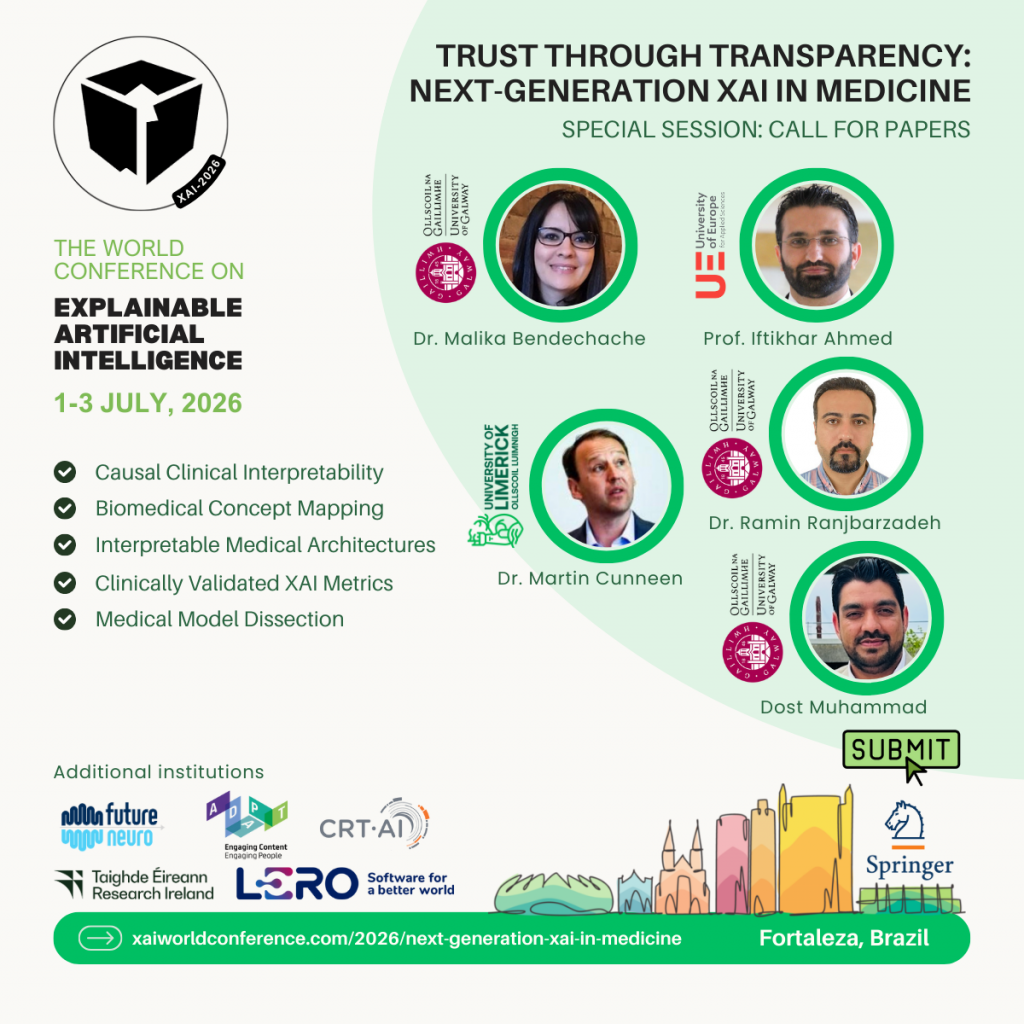
Explainable Artificial Intelligence (XAI) is essential for building transparent and accountable systems in modern medicine. As AI becomes increasingly embedded within diagnostic modelling, medical image analysis, and automated reporting, the need to understand internal model reasoning has become critical. This special session aligns with the mission of the World Conference on XAI by providing a dedicated forum focused on mechanistic, causal, and interpretable-by-design approaches for medical AI, distinguishing it from broader sessions centred on trust, workflow integration, and human factors.
While deep learning models have achieved impressive performance across tasks such as MRI interpretation, CT triage, and pathology assessment, their internal representations remain largely opaque. Widely used post hoc methods, including Grad-CAM, LRP, Integrated Gradients, SHAP, and LIME, often reveal only superficial associations and fail to reflect the biomedical concepts that clinicians use in decision-making. This gap has motivated the emergence of mechanistic interpretability in medicine, which aims to analyse how internal layers, activation circuits, and learned representations map to anatomical structures, pathological features, and causal biomedical mechanisms.
This session seeks contributions that advance interpretability by focusing on model-internal analysis, causal structure, neuro-symbolic reasoning, and interpretable architectures designed specifically for medical tasks. We welcome submissions on mechanistic interpretability in medical report generation, MRI, CT, ultrasound, digital pathology, and multimodal medical imaging. Work on clinically validated evaluation metrics, causal attribution, prototype-based representations, structured concept models, and benchmark creation is particularly encouraged. By centring the session on technical and mechanistic aspects, we provide a complementary focus to other sessions that address usability, clinician cognition, ethics, and workflow integration.
The key objectives of this session are to: 1) Present state-of-the-art research on mechanistic and clinically validated interpretability frameworks for medical AI. 2. Advance understanding of how internal model representations correspond to biomedical concepts, structures, and causal mechanisms. 3. Establish unified benchmarks and metrics for assessing explanation fidelity, clarity, and internal consistency in medical models. 4. Strengthen collaboration between AI researchers and clinicians to support rigorous validation of model-internal explanations.
Through this emphasis on analytical transparency, model dissection, structured representation, and causal reasoning, the session aims to shape the next generation of medical AI systems. These systems should not only achieve high accuracy but should also demonstrate verifiable internal logic that aligns with medical science. The session will provide a platform for researchers to exchange ideas on interpretable model construction, mechanistic discoveries within neural networks, and clinically grounded evaluation standards that support reproducible and accountable AI in medicine.
Keywords: Mechanistic Medical XAI, Causal Clinical Interpretability, Biomedical Concept Mapping, Interpretable Medical Architectures, Clinically Validated XAI Metrics, Neuro-Symbolic Medical Models, Medical Model Dissection, Multimodal Mechanistic Explanations, Representation-Level Transparency, Internal Logic of Medical AI
Topics
- Mechanistic interpretability for brain tumour and lesion diagnosis using deep learning
- Clinically validated evaluation of explainable models for ultrasound-based cancer screening
- Human-in-the-loop explainability for radiology and pathology interpretation
- Interpretable-by-design architectures for disease grading and organ segmentation
- Causal and concept-based explanation models for diabetic retinopathy and cardiac imaging
- Neuro-symbolic and knowledge-guided XAI for oncology and histopathology reasoning
- Explainability in multimodal healthcare systems combining MRI, genomics, medical reports and EHR data
- Standardised benchmarks and validation pipelines for medical XAI evaluation