Recent progress in Artificial Intelligence (AI) is opening new possibilities for chemistry and materials science. These methods are enhancing our ability to model molecular systems, predict material properties, and design new compounds. However, because many machine learning models operate as “black boxes,” their results are often difficult to interpret, which limits their acceptance in sensitive areas such as drug discovery, catalysis, and materials development.
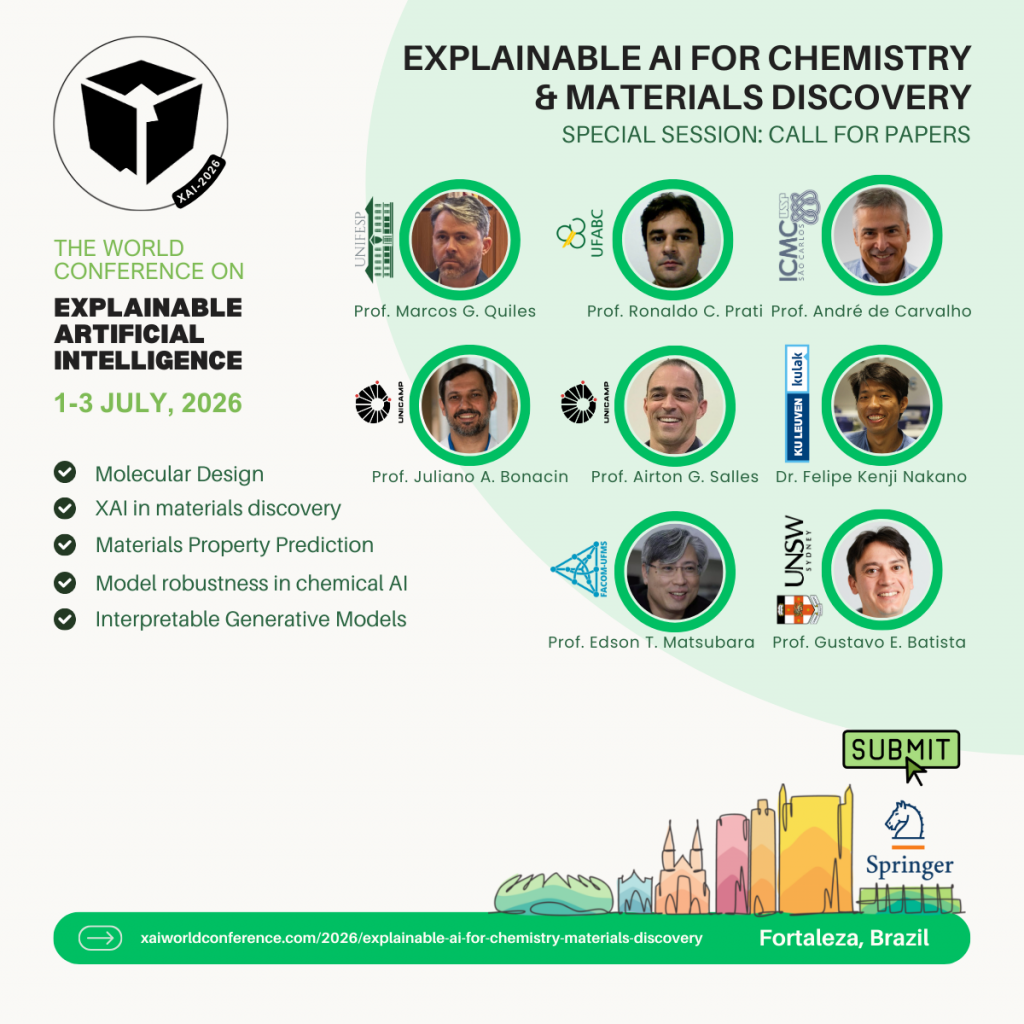
This special session will gather scientists and professionals who work at the intersection of explainable AI (XAI), computational chemistry, and materials informatics. We invite contributions that propose methods, tools, or frameworks designed to make AI outcomes clearer, more transparent, and aligned with chemical and physical reasoning. Both conceptual advances and applied studies demonstrating how explainability can accelerate discovery and enhance trust in AI-driven research are welcome. By encouraging collaboration between AI specialists and chemists, the session aims to promote the development of models that are not only accurate but also insightful from a scientific perspective.
Keywords: Explainable Neural Network, Interpretable Generative Models, Molecular Design, Materials Property Prediction, model robustness in chemical AI.
Topics
- Explainability in molecular property prediction and materials discovery
- Interpretable deep learning architectures for chemistry (e.g., GNNs, transformers)
- Feature attribution and visualization techniques in chemical space
- Explainable generative models for molecule and material design
- Integration of domain knowledge and physical constraints in XAI methods
- Human-in-the-loop and interactive explainability for chemical systems
- Benchmarking and evaluation metrics for explainability in scientific models
- Case studies of XAI in computational chemistry, catalysis, and reaction prediction
- Uncertainty quantification and model robustness in chemical AI
- Ethical and reproducibility challenges in AI-driven chemistry